The High Cost of Manual Assembly: Why eLearning Teams Should Automate the Rise Build

The Invisible Tax on Instructional Design
In most eLearning production cycles, there is a dead zone between the moment a storyboard is approved and the moment the first review link is generated. This phase isn't spent on instructional strategy or visual design. It is spent on the 'copy-paste tax'—the hours required to manually move text, tables, and questions from a document into Articulate Rise.
For a senior instructional designer or developer, this is robotic work. It is tedious, prone to human error, and a poor use of specialized talent. Every minute spent toggling between browser tabs to copy a bulleted list is a minute not spent on refining the learning experience or tightening the narrative flow.
We need to stop treating course assembly as a creative act. It is a production task, and it is time we treated it like one.
Content Parity vs. Content Creation
The biggest risk in automating any part of the instructional design process is the loss of control. Many 'AI' tools attempt to solve the wrong problem by rewriting content or making instructional decisions that they aren't qualified to make. This creates more work for the developer, who then has to audit the AI’s 'hallucinations' against the approved storyboard.
The goal shouldn't be to let a machine write your course. The goal is content parity: a faithful, 1:1 translation of your approved storyboard into a functional Rise course. When a stakeholder signs off on a Word document or a spreadsheet, they expect to see those exact words in the build. Anything else is a quality assurance nightmare.
The Error-Prone Nature of Manual Entry
Manual entry is where small, embarrassing errors creep in. A stray click leads to a missed paragraph; a copy-paste error results in the wrong feedback appearing for a multiple-choice question. These aren't failures of talent; they are failures of process.
By automating the build phase, you remove the opportunity for these 'human-in-the-loop' errors. If the content is correct in the storyboard, it will be correct in Rise. This shifts the focus of your QA cycle from 'Did I include all the content?' to 'Does this content work effectively for the learner?'
How Automation Changes the Workflow
Modern eLearning teams are moving away from manual assembly in favor of structured transitions. Here is what a mature production workflow looks like when you remove the copy-paste phase:
- Final Sign-off: The storyboard is fully approved in its native format.
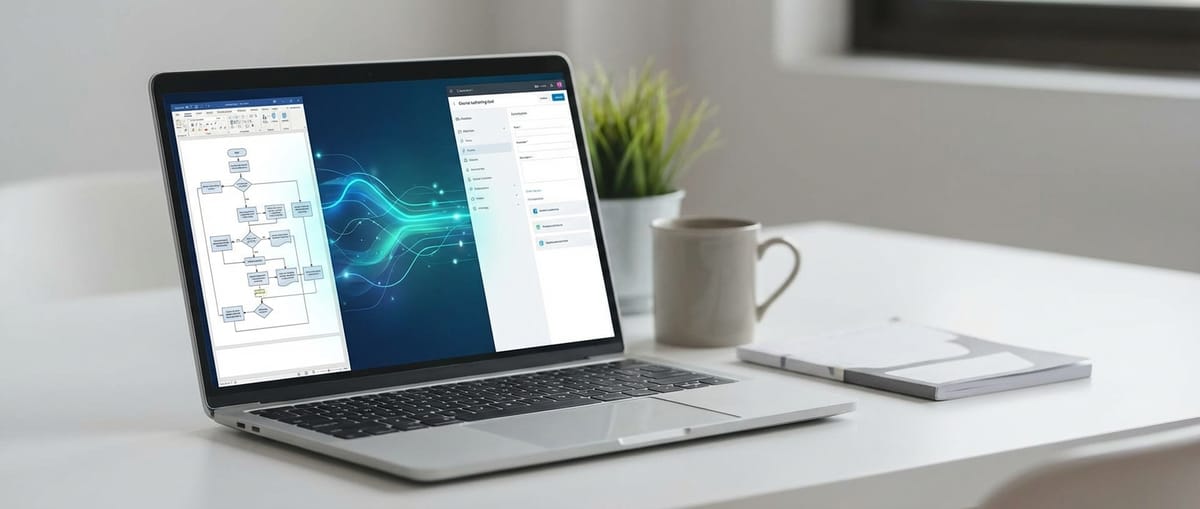
- Structural Mapping: A tool identifies the intended blocks—accordions, knowledge checks, tables, and text—directly from the document.
- Automated Injection: A browser extension handles the heavy lifting, building the lessons and blocks directly inside Rise in minutes.
- Refinement and Polish: The developer spends their time on what humans do best: selecting the right imagery, adjusting the pacing, and ensuring accessibility compliance.
Building for Efficiency, Not Just Speed
This isn't just about moving faster; it’s about protecting the integrity of the instructional design. When you eliminate the mechanical burden of building courses, you reduce burnout and allow your team to focus on the high-value work they were hired to do.
ReviewMyElearning has introduced a Chrome extension designed to solve this exact problem. It doesn't use AI to rewrite your content. It simply takes your approved storyboard and builds it in Rise—accurately, instantly, and ready for your final professional touch.
The manual 'build phase' is a legacy of a less mature industry. It's time to move past it and focus on the craft that matters.